


As the energy transition accelerates, companies across the UK are innovating to make power distribution cleaner and more efficient. One of those pioneers is Enertechnos, whose patented Capacitive Transfer System (CTS) cable is designed to cut losses in transmission and distribution networks. To put their technology to the test, Enertechnos partnered with the Net Zero Technology Centre (NZTC) on a large-scale proving project.
A critical part of the trials was the ability to precisely control and modulate power frequency across an approximately 1.8 km, 3-phase CTS cable. For that, Enertechnos turned to the VEICHI Electric AC310 Variable Frequency Drive (VFD), supplied and supported in the UK by Charter Controls.

Background & Challenge
Enertechnos’ CTS cable works by offsetting the inductive reactance that normally builds up across long lengths of cable. The goal for the NZTC project was to demonstrate how this innovation could minimise impedance and improve overall efficiency.
The challenge lay in recreating realistic operating conditions and measuring how the CTS performed under different parameters. Enertechnos needed a drive system that could:
- Increase frequency well beyond the UK grid’s 50 Hz baseline
- Provide stable, controllable output at 690 V
- Integrate seamlessly with auxiliary equipment
- Deliver high-resolution performance monitoring during live operation
- Put simply, this was a test bed that required both precision and flexibility
Solution Implementation
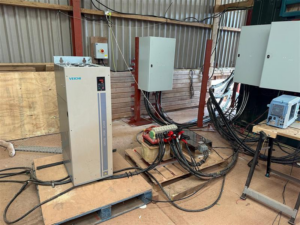
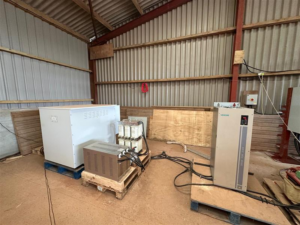
After reviewing options, Enertechnos selected the 320kW Veichi AC310 VFD. Known for its high-performance vector control, STO (Safe Torque Off) functionality, and wide range of expansion interfaces, the AC310 offered the combination of robustness and adaptability the project required.
Crucially, the drive enabled the team to increase the transmitted frequency from the grid standard of 50 Hz to a range of 400–900 Hz at 690 V. This flexibility was not only essential for completing the NZTC trials but will also support Enertechnos’ upcoming proving programmes, including 400 Hz aviation projects and the DIVA (Dynamic Intermittent Variable Asymmetry) system, which tests CTS performance under highly variable, real-world grid conditions.
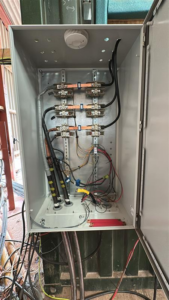
Installation was reported as straightforward and intuitive. Additional auxiliary equipment such as remote control modules were easily sourced as off-the-shelf items and integrated without issue, thanks to the AC310’s compatibility with third-party hardware.
Throughout commissioning, Enertechnos benefited from strong technical collaboration. As Head of Marketing, Isobel Arrowsmith, explained:
“Setting it up was relatively easy and straightforward. The versatility of the VFD enabled us to devise more appropriate operational scenarios to meet the NZTC milestones. The technical team at Veichi and the sales team at Charter Controls were diligent when it came to providing on-the-go support.”
Results & Benefits
The AC310 quickly proved its value in practice. Key benefits included:
Balanced Reactance: By modulating output frequency as a proxy for cable length, engineers successfully balanced the reactance of the 1.8 km CTS cable and achieved minimal impedance.
Real-Time Control: PWM carrier frequency and operational parameters could be adjusted dynamically under live conditions, reducing downtime and improving data accuracy.
Operational Flexibility: Multiple scenarios were tested to validate CTS performance against NZTC milestones, proving the cable’s potential across diverse applications.
Streamlined Integration: With easy compatibility and responsive supplier support, installation and commissioning were achieved within project timelines.
For Enertechnos, this was more than a smooth installation — it was a validation step towards commercialising their technology. For Charter Controls, it underscored the value of pairing innovative clean-tech projects with reliable, high-performance industrial equipment.
Design & Integration Considerations
- The project highlighted several takeaways for industrial innovators:
- Selecting a versatile drive system early in project design simplifies testing and reduces integration risk
- Supplier collaboration is as critical as the hardware itself — responsive support accelerates project delivery
- Compatibility with third-party equipment reduces costs and expands operational possibilities
Project Outcomes and Next Steps
The NZTC project demonstrated how Enertechnos’ CTS cable can deliver on its promise of lower-loss power transmission, while the Veichi AC310 provided the control and precision needed to prove it. Looking ahead, Enertechnos will continue to build on this foundation through additional proving projects, including trials at 400 Hz and the advanced DIVA system.
“Projects like this highlight the importance of not just supplying equipment, but truly supporting innovation at every stage,” says Amir Sami, Director of Sales. “At Charter Controls, we work closely with forward-thinking companies like Enertechnos to ensure they have the flexibility, performance, and technical backing needed to validate new technologies under real-world conditions. As the demands on power systems continue to evolve, having the right drive solution and the right partner behind it can make a critical difference in bringing new ideas to life.”
—
Originally published by Amir Sami for Charter Controls
—